
Updated August 15, 2026
Laundry symbols tell you the safest tested way to wash, bleach, dry, iron, or professionally clean a garment. A washtub refers to washing, a triangle to bleaching, a square to drying, an iron to ironing, and a circle to professional textile care. Extra marks—such as dots, numbers, bars, letters, or an X—modify that basic instruction.
Quick answer: Read the complete care label before cleaning an item. An X means do not use that process. Numbers inside a washtub are maximum water temperatures in Celsius. Dots generally indicate heat level, while one or two bars beneath a symbol call for a milder process. Letters inside a circle are instructions for a professional cleaner, not settings on a household washer.
Laundry Symbols and Their Basic Meanings
| Basic shape | Care category | What to look for |
|---|---|---|
| Washtub | Washing | Machine wash, hand wash, water temperature, mild cycle, or do not wash |
| Triangle | Bleaching | Any bleach, non-chlorine bleach only, or do not bleach |
| Square | Drying | Tumble drying, line drying, drip drying, flat drying, shade, or do not tumble dry |
| Iron | Ironing | Low, medium, or high heat; no steam; or do not iron |
| Circle | Professional care | Professional dry cleaning, professional wet cleaning, process restrictions, or do not dry clean |
Care-symbol systems are not completely identical worldwide. Clothing sold in the United States may use ASTM-style symbols, while imported garments may use ISO/GINETEX-style symbols. The five basic shapes are similar, but temperature dots, natural-drying marks, and professional-care details can vary. Read any accompanying words as well as the symbols.
How to Read Dots, Bars, Numbers, Letters, and Crosses
- An X over a symbol: Do not use that care method. A crossed washtub means do not wash; a crossed triangle means do not bleach.
- One bar underneath: Use a mild or reduced-mechanical-action process.
- Two bars underneath: Use a very mild process with even less mechanical action.
- Numbers in a washtub: The number is the maximum washing temperature in degrees Celsius—not a recommended minimum.
- Dots: Dots usually indicate temperature or heat intensity. More dots generally mean more heat, but apply them only within that symbol’s category.
- Letters inside a circle: These identify professional dry-cleaning or wet-cleaning processes and solvents. They are intended mainly for trained textile cleaners.
Never combine separate symbols into your own interpretation. For example, an iron with one dot describes ironing heat; it does not tell you which washer temperature to select.
Washing Symbols on Clothes
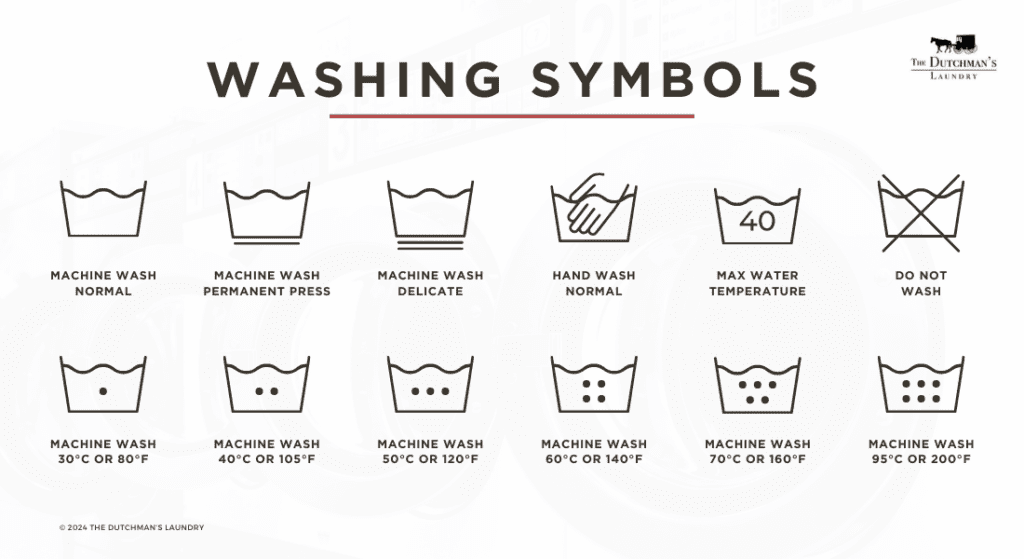
The washtub symbol covers household washing. Look inside and underneath the tub before selecting a cycle.
- Plain washtub: Machine washing is allowed using the process and temperature shown elsewhere on the label.
- Washtub with one bar underneath: Use a mild cycle, often called permanent press or easy care. Reduce mechanical action and follow the label’s temperature instructions.
- Washtub with two bars underneath: Use a very mild or delicate process. This may correspond to a delicate or wool cycle, but confirm the washer’s cycle description.
- Hand inside a washtub: Hand wash at the temperature permitted by the label. Gently move the garment through the water; do not automatically scrub, twist, or wring it.
- Crossed-out washtub: Do not wash the item in water. This does not automatically mean every alternative process is safe; check the rest of the label.
A delicate-cycle symbol does not override fabric-specific instructions. For bras, lace, wool, silk, and fine garments, see our detailed guide to washing delicates and lingerie.
Washing Temperature Symbols: What 30, 40, 60, and Other Numbers Mean
A number inside the washtub states the maximum permitted water temperature in degrees Celsius. You may use a cooler temperature if it is appropriate for the detergent, soil, and cleaning goal, but do not exceed the number on the label.
| Symbol number | Approximate Fahrenheit equivalent | Meaning |
|---|---|---|
| 30°C | 86°F | Do not wash above 30°C |
| 40°C | 104°F | Do not wash above 40°C |
| 50°C | 122°F | Do not wash above 50°C |
| 60°C | 140°F | Do not wash above 60°C |
| 70°C | 158°F | Do not wash above 70°C |
| 95°C | 203°F | Do not wash above 95°C |
What does the 30 laundry symbol mean? A washtub marked “30” means the maximum washing temperature is 30°C, approximately 86°F. It does not, by itself, specify a normal or delicate cycle. Check for one or two bars underneath the tub to determine the required mechanical action.
The washing graphic above uses rounded Fahrenheit labels. When a garment displays a Celsius number, treat that printed Celsius temperature as the controlling maximum.
Drying Symbols and Tumble Dry Meaning
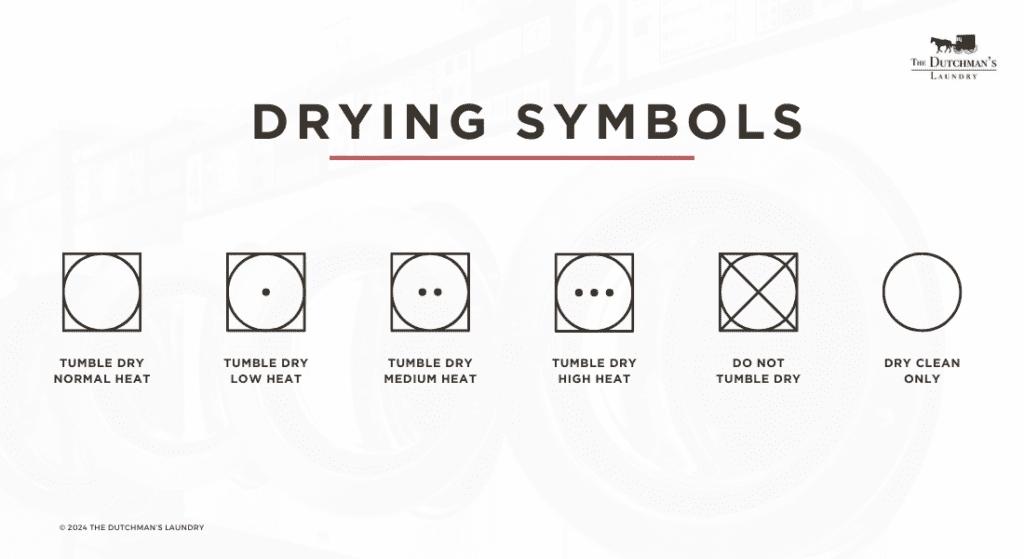
A square represents drying. A circle inside the square means tumble drying in a machine. Lines inside a square refer to natural drying methods.
- Square containing a circle: Tumble drying is permitted.
- One dot inside the tumble-dry symbol: Use low heat or a mild drying process.
- Two dots: Use medium or normal heat, depending on the symbol system and dryer.
- Three dots: On North American labels, this generally permits high heat.
- Crossed square and circle: Do not tumble dry. Use the separate natural-drying instruction on the label.
- Horizontal line in a square: Dry flat.
- Vertical line in a square: Line or hang dry. Multiple vertical lines may indicate drip drying.
- Diagonal line in the upper corner: Carry out the specified natural-drying method in the shade.
Do not assume “do not tumble dry” always means hang the item from a hanger. A wet knit may stretch and could require flat drying instead. Follow the exact natural-drying symbol.
The plain circle labeled “dry clean only” in the graphic is shown for comparison, but a circle by itself is a professional-care symbol rather than a household drying symbol.
Bleaching Symbols
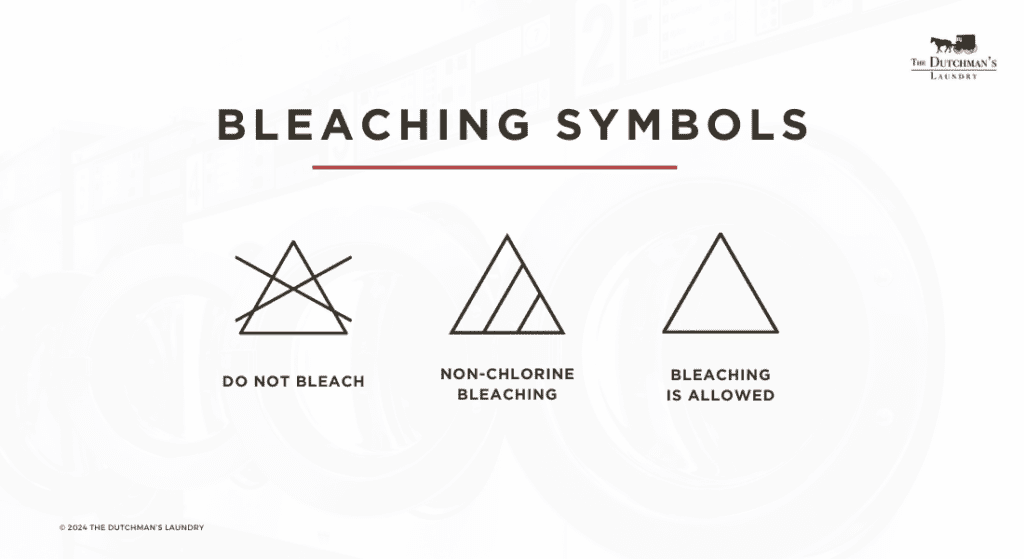
- Empty triangle: Bleaching is allowed when needed. Both chlorine and non-chlorine bleach may be permitted, subject to the product directions.
- Triangle with two diagonal lines: Use only non-chlorine or oxygen bleach when needed. Do not use chlorine bleach.
- Crossed-out triangle: Do not use any bleach.
Bleach permission is not an instruction to add bleach to every load. Use it only when needed and exactly as directed. Never mix chlorine bleach with ammonia, vinegar, acids, or other household cleaners.
Dry-Cleaning and Professional-Care Symbols
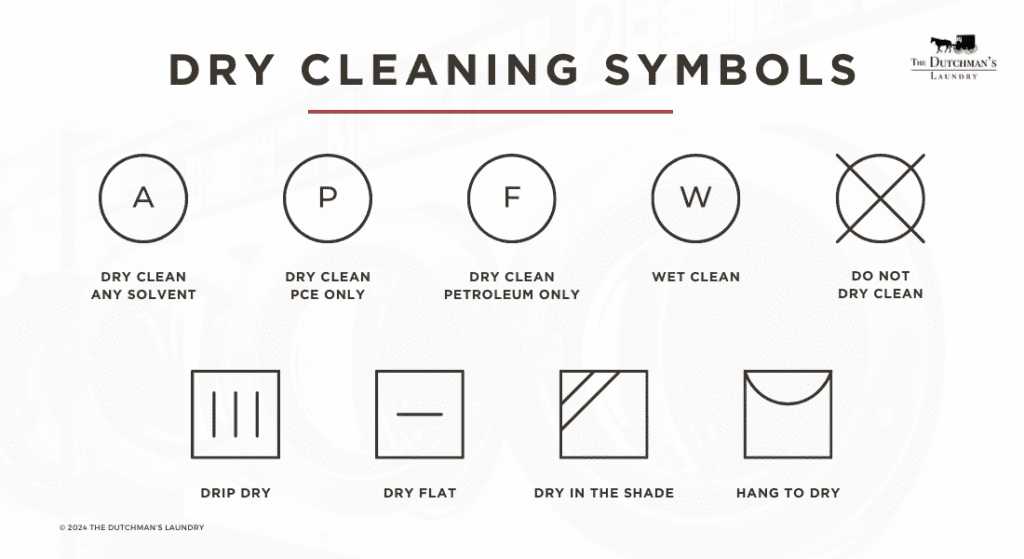
A circle refers to professional textile care. Unlike washer or dryer settings, letters inside the circle primarily tell a professional cleaner which process or solvent category may be used.
- Circle: Professional dry cleaning is permitted. Written instructions may add restrictions.
- A inside a circle: In systems that use it, professional dry cleaning with any normally used solvent is permitted.
- P inside a circle: Professional dry cleaning using perchloroethylene and permitted hydrocarbon processes. This is not a household “P” setting.
- F inside a circle: Professional dry cleaning using hydrocarbon solvents.
- W inside a circle: Professional wet cleaning. This specialized process is not the same as a household gentle or hand-wash cycle.
- One or two bars beneath the circle: The professional cleaner must use a mild or very mild process with additional restrictions.
- Crossed-out circle: Do not professionally dry clean. Do not assume that every solvent-based stain remover is safe.
What is the dry-clean-only symbol?
A plain circle identifies professional dry cleaning, but “dry clean only” is often reinforced with written wording because it warns against washing. If a garment says Dry Clean Only, do not place it in a household washer or hand-wash it based on the fiber name alone. Bring it to a suitable professional cleaner.
The bottom row of the existing infographic contains natural-drying symbols—drip dry, dry flat, dry in the shade, and hang dry. Those square symbols are drying instructions, not dry-cleaning solvent instructions.
Ironing Symbols
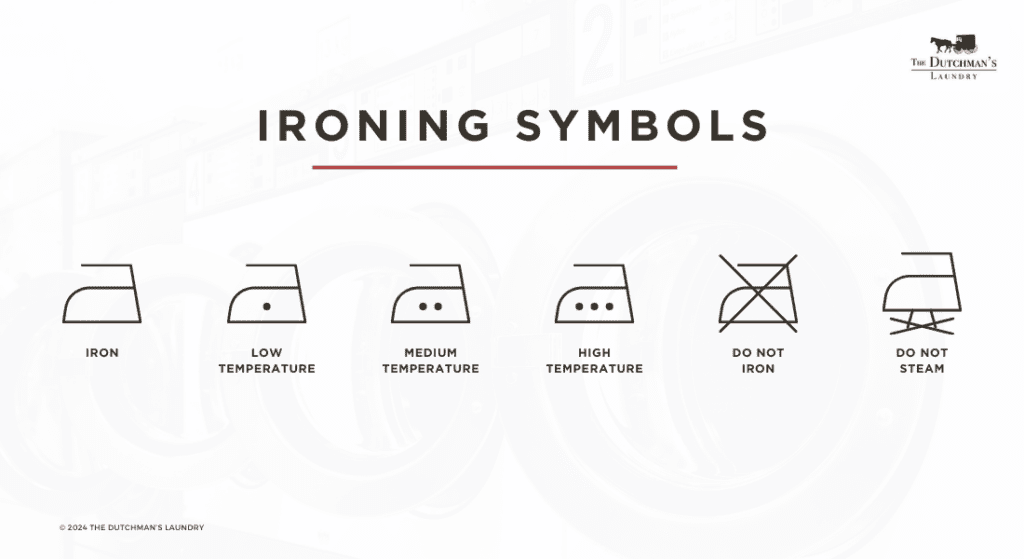
- Plain iron: Ironing is permitted. Use any accompanying heat or steam limitations.
- Iron with one dot: Use low heat. Under the current international system, this corresponds to a maximum soleplate temperature of approximately 120°C.
- Iron with two dots: Use medium heat, approximately 160°C maximum under the international system.
- Iron with three dots: High-temperature ironing is permitted, approximately 210°C maximum under the international system.
- Crossed-out iron: Do not iron. Using an iron may cause irreversible damage.
- Crossed steam lines: Do not steam. If ironing is otherwise allowed, use only the permitted dry-iron setting.
Select heat from the care label—not from a guess based on fiber content. Blends, finishes, prints, adhesives, and embellishments can require less heat than the main fabric.
What If a Garment Has No Care Label?
- Search for the manufacturer’s instructions. Use the brand, style number, item code, and exact product description when available.
- Check every component. Lining, trim, padding, elastic, prints, beads, interfacing, and adhesives may need different care than the main fiber.
- Do not assume fiber content is a complete instruction. Two cotton or polyester garments can have different dyes, finishes, and construction.
- Avoid untested heat, bleach, and stain treatments. Spot-testing cannot prove that the entire garment is safe to wash or dry.
- Seek appropriate professional advice. This is especially important for valuable, vintage, structured, embellished, damaged, leather, suede, or color-unstable items.
If the label is present but a specific wash temperature is confusing, review our guide to hot and cold water for laundry stains. The care-label maximum still controls.
Frequently Asked Questions
What do the symbols on clothing tags mean?
They provide instructions for washing, bleaching, drying, ironing, and professional textile care. Start with the symbol’s basic shape, then read its dots, bars, numbers, letters, and crosses.
What does one line under a washing symbol mean?
One bar beneath the washtub calls for a mild process with reduced mechanical action. Two bars call for a very mild process. Select a washer cycle that matches the label and your machine’s manual.
What does P mean on a laundry symbol?
A P inside a circle is intended for a professional cleaner. It permits professional dry cleaning with specified solvent processes, including perchloroethylene and permitted hydrocarbons. It is not a home washer setting.
What does tumble dry mean?
Tumble dry means the garment may be dried in a rotating machine dryer. The dots inside the circle-and-square symbol state the permitted heat level. A crossed tumble-dry symbol means do not use a machine dryer.
Does a crossed-out circle mean do not dry?
No. A crossed circle means do not professionally dry clean. A crossed circle inside a square means do not tumble dry. The surrounding square changes the category from professional care to drying.
Is 30°C the same as 30°F on a washing label?
No. A “30” inside a washtub normally means 30 degrees Celsius, approximately 86 degrees Fahrenheit. It is the maximum water temperature permitted by that label.
Can The Dutchman’s Laundry handle dry-clean-only garments?
Our listed services are laundry services rather than dry cleaning. Do not place a dry-clean-only garment in a self-service washer or drop it off without confirming that an appropriate service is available. Use a suitable professional dry cleaner for items labeled dry clean only.
Using Care Labels at The Dutchman’s Laundry
For items whose labels permit routine machine washing and drying, The Dutchman’s Laundry offers self-service laundry in Clarksville and drop-off wash and fold. Show the complete label to an attendant and confirm special-care requirements before leaving a delicate, valuable, damaged, hand-wash-only, line-dry-only, or otherwise restricted item.
Laundry Symbol Guide: Key Takeaways
- Washtub means washing; triangle means bleaching; square means drying; iron means ironing; circle means professional care.
- An X prohibits the care process shown underneath it.
- One bar means mild treatment, while two bars mean very mild treatment.
- Numbers in a washtub are maximum temperatures in degrees Celsius.
- Dots indicate heat intensity within washing, drying, or ironing symbols.
- Letters P, F, A, and W inside circles are professional-care instructions.
- A circle alone and a circle inside a square do not mean the same thing.
- Read the entire label and follow written warnings whenever they appear.