
Updated August 15, 2026
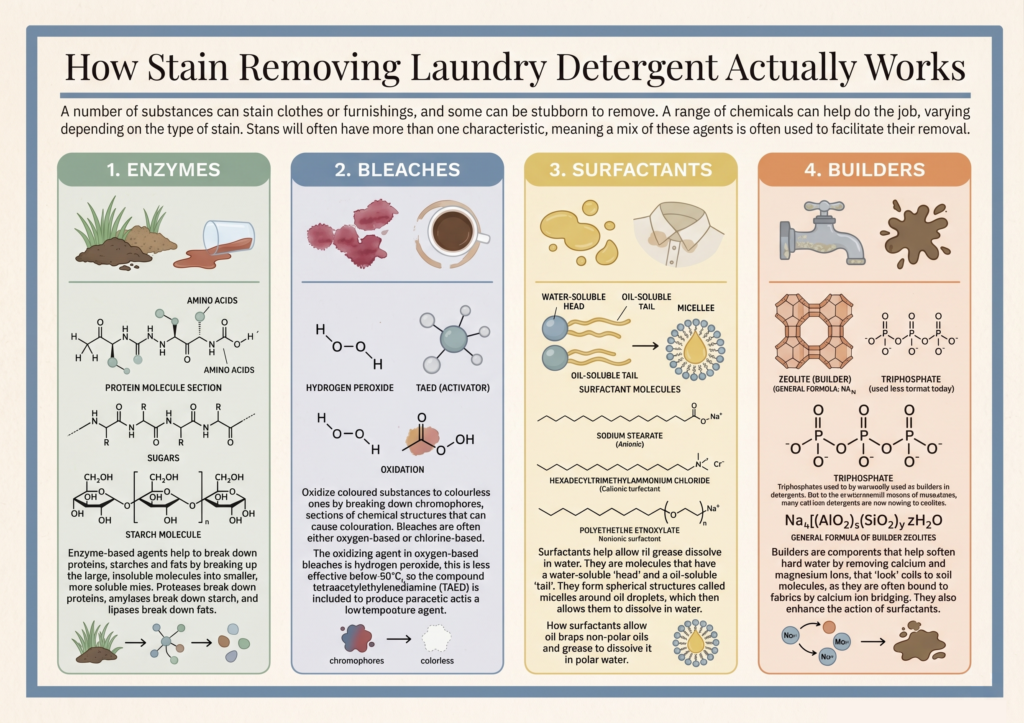
How does laundry detergent remove stains? It combines several cleaning ingredients that loosen soil, break larger stain molecules into smaller pieces, suspend the released material in wash water and help prevent it from settling back onto clothes. Surfactants perform much of the lifting, while enzymes, builders, polymers and bleaching ingredients handle specific cleaning challenges.
Detergent cannot remove every stain by itself. Results also depend on the stain type, fabric, water temperature, cycle, pretreatment, load size and how quickly the stain is treated.
Quick explanation
- Water wets the fabric and begins loosening water-soluble soil.
- Surfactants attach to oil, dirt and other material that water cannot easily remove.
- Enzymes break certain proteins, starches and fats into smaller pieces.
- Builders reduce interference from hard-water minerals.
- Polymers and anti-redeposition agents help keep released soil suspended.
- Mechanical movement helps detach the soil, which leaves with the rinse water.
What Ingredients in Laundry Detergent Remove Stains?
There is no single universal detergent recipe. Formulas differ by brand, product type and intended use. However, many modern laundry detergents use some combination of the following ingredients.
| Ingredient group | Primary purpose | Common cleaning target |
|---|---|---|
| Surfactants | Wet fabric, loosen soil and suspend oily material in water | Body oils, grease, makeup and general dirt |
| Enzymes | Break specific stain molecules into smaller components | Protein, starch, fat and some food stains |
| Builders and chelating agents | Control minerals and improve washing conditions | Hard-water interference and mineral-related dullness |
| Polymers and anti-redeposition agents | Keep released soil and dyes from settling back onto fabric | Suspended dirt and loose dye in wash water |
| Oxygen-based bleaching ingredients | Alter some colored stain compounds and brighten compatible fabric | Certain food, beverage and discoloration stains |
| Optical brighteners | Change how fabric reflects light | Perceived whiteness and brightness—not actual stain removal |
| Fragrance and odor-control ingredients | Add scent or help control odor | Product freshness and residual odor |
How Do Surfactants Remove Dirt and Grease?
Surfactants are central to the way laundry detergent works. A surfactant molecule has two chemically different parts:
- A hydrophilic head that interacts with water
- A hydrophobic tail that is attracted to oil and other non-water-soluble material
During washing, the oil-attracting portion associates with greasy soil while the water-attracting portion remains in the wash water. Groups of surfactant molecules can surround loosened oily material in structures commonly described as micelles. This helps keep the material dispersed in water so it can leave during draining and rinsing.
Surfactants also reduce water’s surface tension. This helps the wash solution spread across fabric and reach soil between fibers more effectively than water alone.
Laundry detergents commonly use anionic and nonionic surfactants. Anionic surfactants provide broad cleaning and soil suspension, while nonionic surfactants are particularly useful against oily soil. Cationic surfactants are more commonly associated with fabric-softening products than with the main cleaning system in ordinary detergent.
What Do Enzymes in Laundry Detergent Do?
Enzymes are proteins that act as catalysts. In detergent, they accelerate reactions that break certain stains into components that surfactants and wash water can remove more easily.
Different enzymes target different substances:
- Protease: Breaks bonds in protein-based stains such as blood, egg and dairy residue.
- Amylase: Acts on starch from foods such as potatoes, rice, pasta and sauces.
- Lipase: Helps break down fats, oils and greasy body soil.
- Mannanase: Targets certain thickening gums found in foods, sauces and personal-care products.
- Cellulase: Acts on small cellulose fibers and can help improve the appearance of compatible cotton fabrics.
- Pectate lyase: Targets pectin-containing food stains, including some fruit- and vegetable-based residues.
Not every detergent contains every enzyme. Check the product’s ingredient information and intended uses when choosing an enzyme detergent for a recurring stain problem.
Fabric warning: Protease-containing detergents may not be suitable for protein-based fibers such as wool and silk. Always follow the detergent label and garment care instructions.
How Does Laundry Detergent Remove Different Types of Stains?
A detergent performs best when its ingredients match the chemistry of the stain. This is why one product or washing method may work well on grease but perform poorly on blood or dye transfer.
| Stain type | Examples | What helps remove it |
|---|---|---|
| Oil and grease | Cooking oil, butter, makeup, body oils | Surfactants, sometimes lipase, pretreatment and a care-label-safe temperature |
| Protein | Blood, egg, milk and some bodily stains | Cool or cold rinsing, protease detergent when fabric-safe and pretreatment |
| Starch | Potato, pasta, rice, gravy and starchy sauces | Amylase, surfactants and sufficient wash time |
| Colored food and drink | Coffee, tea, wine, fruit and tomato sauce | Prompt rinsing, compatible enzymes, surfactants and a fabric-safe oxygen product when allowed |
| Particulate soil | Dust, clay, loose dirt and soot | Surfactants, builders, polymers, adequate movement and rinsing |
| Dye or ink | Pen ink and transferred clothing dye | A stain-specific treatment; ordinary detergent alone may not be enough |
For specific examples, see our guides to removing blood from sheets and bedding and getting grease stains out of clothes.
What Do Builders and Water Softeners Do?
Hard water contains calcium and magnesium ions that can reduce cleaning efficiency. Builders and chelating ingredients bind or otherwise manage these minerals so surfactants can concentrate on removing soil.
Depending on the formulation, builders can also help maintain useful washing conditions and keep loosened material dispersed. Common builder or water-conditioning ingredients include citrates, carbonates, zeolites and other mineral-binding compounds.
If detergent appears ineffective or leaves deposits despite correct loading and rinsing, water hardness may be contributing. Follow the detergent’s hard-water dosing instructions rather than adding an arbitrary amount of extra product.
How Do Polymers Keep Dirt From Returning to Clothes?
Removing soil from fabric is only part of the cleaning process. The released material must remain suspended until the machine drains.
Anti-redeposition polymers help keep loosened soil and some loose dyes from settling onto another part of the garment or a different item in the load. Without this support, material removed early in the cycle could redeposit before the rinse is complete.
This is one reason that too little water movement, overloading or an unsuitable cycle can affect results even when the detergent contains effective cleaning ingredients.
Do Bleaching Ingredients Remove Stains?
Some detergents—particularly certain powder products—contain oxygen-based bleaching ingredients. These can alter colored stain molecules and brighten compatible fabrics. Formula content varies, so never assume that a detergent contains bleach unless its label says so.
Optical brighteners perform a different job. They affect how light reflects from fabric, making some items appear brighter or whiter, but they do not physically remove a stain.
Chlorine bleach is a separate laundry product and should only be used when the garment care label and bleach instructions permit it. Never mix bleach with ammonia, vinegar or another household cleaner.
Liquid vs. Powder vs. Laundry Pods
The best form depends on the washer, stain, water temperature and how much dosing flexibility you need.
Liquid detergent
- Dissolves readily in cold and warm water
- Can often be used for direct pretreatment when the label allows
- Is convenient for adjusting the dose to different load sizes
- Can be useful for oily or greasy soil
Powder detergent
- Can contain ingredients that are easier to stabilize in a dry formula
- May be economical depending on the product and dose
- Needs proper dispensing and enough water to dissolve completely
- Should be stored in a dry location to prevent clumping
Single-dose pods or packets
- Provide a convenient premeasured dose
- Offer less flexibility for very small loads
- Should normally be placed in the empty washer drum before clothing, following the package directions
- Must be stored securely away from children and pets
No format is automatically best for every stain. Ingredient system, correct dosing and proper use matter more than whether the product is a liquid, powder or packet.
Why Does Water Temperature Affect Detergent?
Temperature influences stain behavior, detergent dissolution, enzyme activity, fabric dyes and energy consumption. The hottest available setting is not automatically the most effective or safest.
- Cold water: Suitable for many routine loads and modern detergents. It helps protect many colors and reduces the energy used for water heating.
- Warm water: May help with body oils and some greasy soil when the fabric permits it.
- Hot water: May be appropriate for certain washable, colorfast items, but it can shrink fabric, fade dyes or make some protein stains more difficult to remove.
Start blood, egg and similar protein stains with cool or cold water. For every load, follow the garment care label and detergent instructions. Learn more in our guide comparing quick wash and full wash cycles.
Why Detergent Sometimes Fails to Remove a Stain
Even a well-formulated detergent may leave a stain behind when the washing conditions do not match the problem.
- The stain was not pretreated: Concentrated or dried soil may need time with a compatible pretreatment.
- The wrong chemistry was used: Ordinary surfactants may not remove dye, rust, paint or ink.
- The load was overloaded: Water and detergent could not circulate freely.
- Too much detergent was added: Excess suds and residue can interfere with washing and rinsing.
- Too little detergent was used: There may not be enough cleaning chemistry for the soil level and water conditions.
- The cycle was too short: The ingredients did not have enough time to work.
- The temperature was unsuitable: It may have set the stain or failed to loosen oily material.
- The stain entered the dryer: Dryer heat can make many remaining stains harder to remove.
- The detergent was incompatible with the fabric: Delicate fibers may require a specialized product.
If the product itself left visible residue, use our instructions for removing laundry detergent stains.
Does More Detergent Produce Cleaner Clothes?
No. More detergent does not automatically create greater cleaning power. Excess detergent can produce too many suds, interfere with rinsing, leave residue on fabric and contribute to buildup inside the washer.
Measure detergent according to:
- Load size
- Soil level
- Water hardness
- Product concentration
- The washer manufacturer’s instructions
If your washer carries the HE symbol, use an HE detergent. HE products are formulated to create lower levels of quick-dispersing suds for machines that use less water.
How to Choose the Right Laundry Detergent
- Check the washer requirements. Use HE detergent when required.
- Consider your common stains. Look for a compatible multi-enzyme product if your household frequently deals with food, oil or protein stains.
- Review fabric restrictions. Wool, silk, activewear and waterproof materials may require specialized detergent.
- Consider skin and fragrance needs. A fragrance-free or dye-free product may be preferable for sensitive households. See our guide to choosing the best laundry detergent for sensitive skin.
- Account for water hardness. Follow the product’s hard-water dosing instructions when applicable.
- Check environmental claims. The EPA Safer Choice label provides a more useful verification than vague, unregulated marketing terms alone.
- Follow the dose. Concentrated products may require much less than older formulas.
Frequently Asked Questions
What ingredient in detergent actually removes stains?
There is no single ingredient responsible for every stain. Surfactants provide much of the general soil and grease removal, while enzymes, builders, polymers and bleaching ingredients perform supporting or stain-specific jobs.
How do surfactants lift stains?
Surfactants have a water-attracting section and an oil-attracting section. They associate with oily soil, help loosen it from fabric and keep it dispersed in wash water so it can be rinsed away.
Do enzymes remove every type of stain?
No. Enzymes are selective. Protease acts on protein, amylase on starch and lipase on fats. Dye, rust, ink or paint may require a different treatment.
Can enzyme detergent damage clothes?
It can be unsuitable for certain materials. Protease-containing products may affect protein-based fibers such as silk and wool. Always follow the garment and detergent labels.
Why do stains reappear after washing?
A mark may be less visible while the fabric is wet and become noticeable again after drying. It can also result from incomplete stain removal, residue or redeposition. Inspect the item before using the dryer and repeat a compatible treatment if needed.
Does cold water stop detergent from working?
No. Many modern detergents are formulated to clean effectively in cold water. However, performance depends on the formula and stain. Oily soil may respond better to warmer water when the care label permits it.
Is expensive detergent always better?
No. Price alone does not reveal cleaning performance. Compare the formula’s intended use, enzymes, dosing, washer compatibility and performance on the stains your household encounters.
Is fragrance the same as cleaning power?
No. Fragrance changes how laundry smells but does not prove that body soil, oils or stain residue were removed. Effective cleaning depends on the complete detergent system and washing conditions.
Use the Right Detergent in the Right Machine
Detergent works best when the machine is correctly loaded and the cycle matches the fabric and soil level. The Dutchman’s Laundry offers self-service Speed Queen washers in Clarksville ranging from 2-load to 8-load capacity.
Select wash cycles can finish in as little as 23 minutes, depending on the machine and cycle. Larger machines can also help you avoid packing oversized washable loads into a home washer that does not provide sufficient room for movement.
If you would prefer assistance with eligible everyday laundry, review our drop-off wash-and-fold service. Stain removal results can vary according to the fabric, stain type, age and previous treatment, so identify known stains when handing over a load.
Key Takeaways
- Surfactants loosen soil and help suspend oily material in water.
- Enzymes break specific protein, starch, fat and food-stain components into smaller pieces.
- Builders manage hard-water minerals that can interfere with cleaning.
- Polymers help prevent released soil from settling back onto fabric.
- Optical brighteners change appearance but do not physically remove stains.
- Water temperature, cycle time, load size and pretreatment all affect detergent performance.
- More detergent is not necessarily better; measure according to the product and load.
- No detergent can safely remove every stain from every fabric.
Sources Reviewed
This guide was reviewed against detergent and cleaning information from the American Cleaning Institute, ACI’s enzyme-product guidance, the American Chemical Society, EPA Safer Choice, ENERGY STAR and Whirlpool’s HE detergent guidance.
About the TDL Team
The TDL Team is the editorial team at The Dutchman’s Laundry in Clarksville, Tennessee. Our laundry-care articles combine practical laundromat experience with appliance-manufacturer instructions and authoritative cleaning guidance. This article was last reviewed on August 15, 2026.