Updated August 15, 2026
Is it cheaper to use a laundromat or wash at home? If you already own an efficient washer and dryer, have space for them, and do laundry regularly, washing at home is usually cheaper per load. A laundromat can be cheaper overall when you would otherwise need to purchase and install appliances, expect to move soon, lack washer connections, face repair costs, or need large machines for several loads or bulky bedding.
The right answer depends on more than the price of one wash cycle. A fair comparison should include appliance ownership, electricity, water and sewer usage, detergent, repairs, laundromat machine prices, transportation, load capacity, and how many loads you wash.
Quick verdict
- Already own reliable machines? Washing at home is normally the least expensive option.
- Need to buy and install both appliances? Compare the purchase cost with the number of loads you expect to wash before moving or replacing them.
- Renting without hookups or moving soon? A laundromat can cost less than buying appliances.
- Washing several loads or bulky bedding? Large laundromat machines can combine laundry that would require multiple home cycles.
- Want the lowest possible home cost? Wash full loads in cold water when appropriate and air-dry suitable items.
Laundromat vs. Home Laundry: The Main Cost Difference
Home laundry and laundromat laundry charge you in different ways.
| Cost factor | Washer and dryer at home | Self-service laundromat |
|---|---|---|
| Upfront expense | Appliance purchase, delivery, installation and possible hookup work | None |
| Per-use expense | Electricity, water, sewer and supplies | Washer, dryer, supplies and transportation |
| Repairs | Paid by the owner after warranty coverage ends | No appliance repair expense for the customer |
| Capacity | Usually one household-size load at a time | Multiple machine sizes, including equipment for several loads and bulky items |
| Convenience | Available without leaving home | No appliance ownership; several loads can run simultaneously |
The direct operating cost at home is often lower, but that comparison changes when the purchase price and repair risk of the appliances are included.
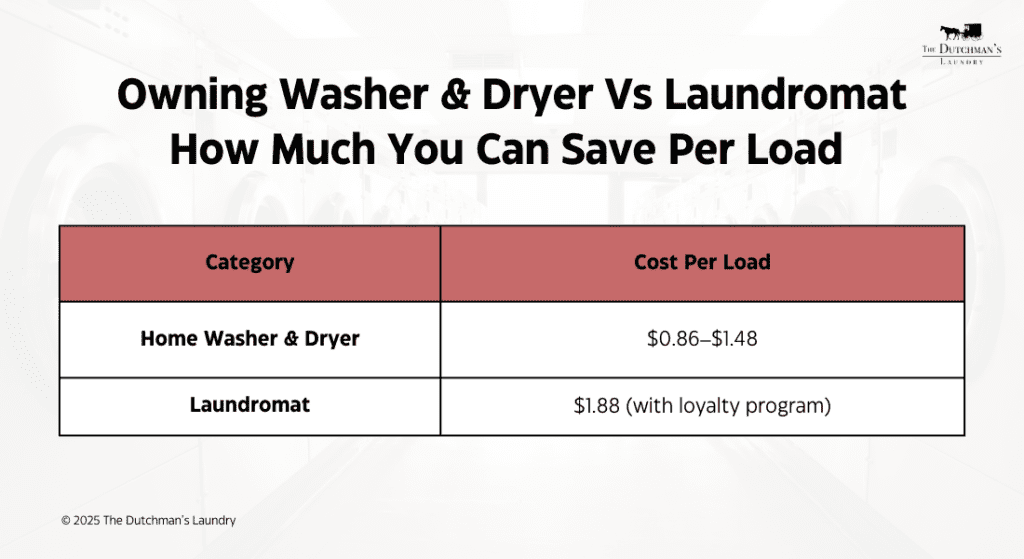
How Much Does a Load of Laundry Cost at Home?
There is no reliable universal price for one home laundry load. The answer changes according to the washer, dryer, utility rates, water temperature, load size, detergent, and whether the appliances are already paid for.
Use this calculation:
Home cost per load = appliance ownership cost per load + electricity + water and sewer + detergent and other supplies
1. Appliance ownership cost
Add the purchase price, delivery, installation, hookup expenses, and expected repairs. Subtract any expected resale value. Divide the result by the number of loads you expect to wash during the years you own the machines.
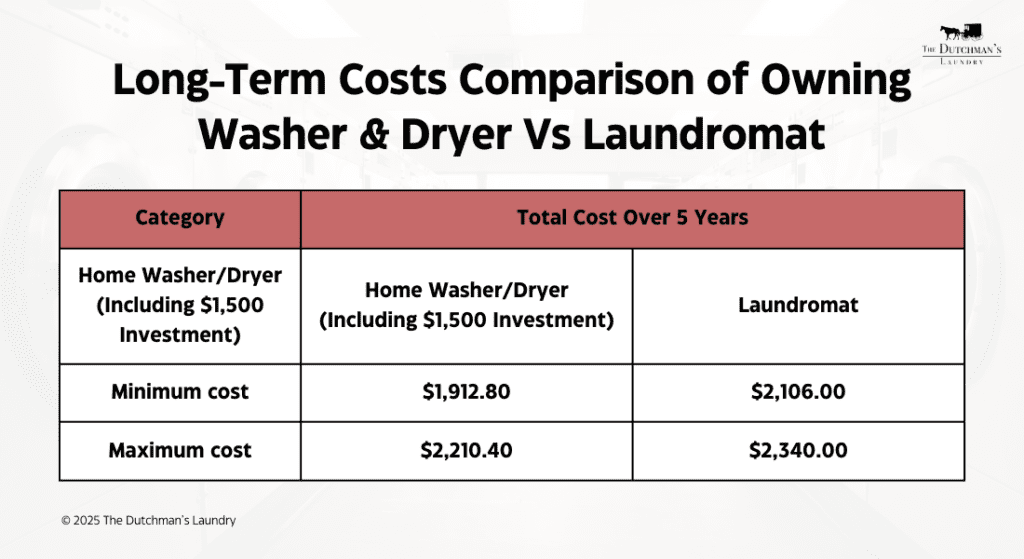
For example, assume—not as a market price, but as an illustration—that a household spends $1,500 purchasing and installing a washer and dryer and another $300 on repairs. If it washes four loads per week for five years, the calculation would be:
- Four loads × 52 weeks × five years = 1,040 loads
- $1,800 in appliance and repair expenses ÷ 1,040 loads = approximately $1.73 per load
- Electricity, water, sewer, and supplies must then be added
Someone who keeps the appliances longer or washes more frequently spreads the ownership cost across more loads. Someone who moves after one year may not.
2. Electricity
Electricity use varies significantly between machines. The washer uses electricity to operate, while the dryer generally represents a larger share of the electrical expense. Heating water can also add to the cost when a warm or hot wash is selected.
The U.S. Energy Information Administration reported a Tennessee residential electricity price of approximately 14.47 cents per kilowatt-hour in May 2026. Your actual Clarksville bill and rate structure may differ, so use the price shown on your utility statement when calculating your cost.
3. Water and sewer usage
ENERGY STAR reports that a full-size certified washer uses approximately 14 gallons of water per load, compared with about 20 gallons for a standard machine. Older or less efficient equipment may use more.
Multiply the washer’s gallons per cycle by the variable water and wastewater rates shown on your bill. Avoid assigning the entire monthly utility bill to laundry because fixed account charges would normally exist even if you washed elsewhere.
4. Detergent and supplies
Include detergent, stain treatment, fabric softener when used, dryer sheets, and any other products added to the load. Concentrated detergent can cost less per load when it is measured correctly. Using more detergent than recommended usually increases cost without improving cleaning.
5. Repairs and replacement
A home machine may operate for years without a major problem, or it may require service after its warranty expires. Because the timing and price of repairs cannot be predicted precisely, test more than one scenario rather than assuming repair costs will always be zero.
How Much Does It Cost to Use a Laundromat?
A laundromat’s cost depends on the washer size, dryer size, cycle selections, supplies, and transportation. Comparing only the cheapest washer with a complete home wash-and-dry load would not be fair, so include both washing and drying.
For this comparison, use the self-service machine prices below. For a fuller breakdown of washer and dryer costs, see our laundromat pricing guide.
| Machine | Current starting price |
|---|---|
| Top-load washer | $3.75 |
| 2-load washer | $4.00 |
| 4-load washer | $6.00 |
| 6-load washer | $8.50 |
| 8-load washer | $10.50 |
| 30-pound dryer | $2.50 |
| 45-pound dryer | $4.00 |
| 75-pound dryer | $5.00 |
For example, one top-load wash and one 30-pound dryer cycle currently start at $6.25 before detergent or transportation. At the other end, one 8-load washer and one 75-pound dryer cycle start at $15.50. The actual total can change if a load needs extra drying time or a different machine combination.
Machine pricing and cycle options may change. Always check the price displayed on the machine before beginning a cycle.
Large machines can change the per-load comparison
A laundromat becomes more cost-efficient when you fully use a high-capacity washer to combine laundry that would require several home cycles. However, “2-load,” “4-load,” and similar labels are approximate capacity descriptions—not guaranteed conversions for every household basket.
Heavy towels, comforters, blankets, and loosely packed clothing occupy machines differently. Compare the total laundry you can wash safely, not just the name printed on the machine.
Loyalty rewards reduce future laundry spending
The Dutchman’s Laundry offers a free loyalty-card program that provides 10% back on eligible wash and dry cycles. For every $30 spent on eligible cycles, the customer earns $3 back for future laundry.
This is a reward rather than an immediate reduction in the displayed machine price. Learn more about the laundromat loyalty program.
How to Calculate Your Break-Even Point
Instead of relying on a national average, use your household’s actual numbers.
- Estimate how long you will remain in the home. Use a realistic ownership period rather than the maximum possible appliance life.
- Calculate expected loads. Multiply loads per week by 52 and then by the number of years.
- Calculate ownership cost per load. Add purchase, delivery, installation, hookup work, and expected repairs. Subtract resale value and divide by expected loads.
- Add operating costs. Include electricity, water, wastewater, detergent, and drying.
- Calculate your laundromat trip. Add the washer, dryer, supplies, and transportation you would actually use.
- Compare equivalent amounts of laundry. Account for the larger capacity of commercial machines when appropriate.
Break-even formula
Break-even loads = total appliance ownership cost ÷ savings per load from washing at home
Suppose owning the appliances costs $1,800 before utilities and saves an estimated $3 per equivalent load compared with your actual laundromat routine. The break-even point would be 600 loads. At four loads per week, that would take approximately 150 weeks, or just under three years.
That example changes immediately if the appliances cost more, require a repair, are sold when you move, or if you combine several household loads in one commercial machine.
When Is Washing at Home Cheaper?
Home laundry is more likely to have the lowest total cost when:
- You already own the washer and dryer
- The appliances are efficient and reliable
- Your home already has suitable hookups
- You expect to remain in the home for several years
- You wash frequently enough to spread the purchase cost across many loads
- You usually wash full loads
- You use cold water where care labels and cleaning needs allow
- You air-dry some items instead of machine drying everything
- The convenience of washing at home matters more than completing multiple loads simultaneously
When Can a Laundromat Be Cheaper?
A self-service laundromat may provide the lower overall cost when:
- You would otherwise have to purchase both appliances
- Your rental does not have washer and dryer connections
- Installation requires plumbing, electrical, gas, or venting work
- You expect to move before recovering the appliance investment
- You wash infrequently
- You need a large machine only occasionally
- You regularly wash comforters, blankets, or several baskets at once
- You want to avoid appliance repairs and replacement risk
- You can combine multiple home-sized loads in one appropriately filled commercial washer
What Is the Cheapest Way to Do Laundry?
If you already own suitable appliances, the lowest direct-cost approach is usually to wash full loads, use cold water when appropriate, measure detergent correctly, choose an efficient spin cycle, and air-dry suitable items.
If you do not own appliances, compare the number of loads you expect to wash before buying anything. A laundromat may be the cheaper choice for renters, students, military families expecting a move, and anyone without permanent laundry hookups.
At a laundromat, you can reduce your effective cost by:
- Choosing the smallest machine that fits the laundry without overfilling
- Combining loads appropriately in a larger washer
- Using a high spin setting when suitable to reduce retained water
- Moving laundry promptly to an adequately sized dryer
- Avoiding unnecessary extra drying time
- Bringing correctly measured detergent
- Using available loyalty rewards
Time and Capacity Also Have Value
Financial cost is only one part of the decision. A home washer processes loads one after another. At a laundromat, multiple washers can run at the same time, and larger machines can accommodate laundry that may require several home cycles.
At The Dutchman’s Laundry, washer options range from top-load and 2-load machines to 4-, 6-, and 8-load washers. Dryers are available in 30-, 45-, and 75-pound capacities. Wash cycles can finish in as little as 23 minutes depending on the machine and selected cycle, although total visit time also includes loading, drying, and folding.
Large equipment can be particularly useful for family laundry, towels, blankets, and washable comforters. Review our large-capacity washer and dryer information before washing an oversized item.
Which Option Is Better for You?
| Situation | Option more likely to fit | Reason |
|---|---|---|
| You already own reliable appliances | Home laundry | The purchase cost has already been paid |
| You need to buy both machines but may move soon | Laundromat | Avoids a large upfront investment |
| You wash frequently and plan to stay long-term | Home laundry | Ownership cost is spread across more loads |
| Your rental has no laundry hookups | Laundromat | No installation or appliance storage required |
| You need to wash several loads simultaneously | Laundromat | Multiple and high-capacity machines are available |
| You prioritize doing laundry without leaving home | Home laundry | Offers at-home convenience |
| You do not want to wash or fold the laundry yourself | Drop-off service | The laundry team handles washing, drying, and folding |
The cheapest option is not automatically the best option. Calculate the cash cost first, then consider travel, available space, repair risk, machine capacity, and the value of your time.
Self-Service Laundry in Clarksville, TN
The Dutchman’s Laundry is located at 551 Dover Rd, Clarksville, TN 37042. The self-service laundromat is open daily from 5 AM to midnight, and no appointment is required.
Available amenities include free Wi-Fi, air conditioning, televisions, a kids’ play area, vending machines, a restroom, folding areas, and attendants during attended hours.
Compare the current machine options before your visit
View our coin-operated laundry prices and hours, or call (931) 896-2600 if you need help choosing a machine.
For washable comforters and oversized loads, see our bulky-item laundry options.
Frequently Asked Questions
Is it cheaper to go to a laundromat or wash at home?
Washing at home is usually cheaper per load if you already own efficient, reliable appliances. A laundromat may be cheaper overall if you must buy and install machines, expect to move soon, lack hookups, wash infrequently, or can combine several home loads in one large commercial machine.
Is it cheaper to buy a washer or go to a laundromat?
Buying a washer can be cheaper over a long ownership period with frequent use. A laundromat may cost less over a short period because it avoids the purchase, installation, repair, and replacement costs associated with owning appliances. Calculate your expected loads and break-even point before deciding.
How much does a load of laundry cost at home?
There is no single price. Add the appliance ownership cost per load, electricity, water, wastewater, detergent, and drying. Someone who already owns efficient appliances will have a lower cost than someone who must purchase and install a new washer and dryer.
How much does it cost to use a laundromat?
Prices depend on the washer and dryer selected. At The Dutchman’s Laundry, washers currently range from $3.75 to $10.50, while dryers range from $2.50 to $5.00. Supplies, transportation, and any additional drying time should also be included.
What is the cheapest way to do laundry?
If you already own a washer, washing full loads in cold water when appropriate and air-drying suitable items is usually the lowest direct-cost method. Without appliances or permanent hookups, using a correctly sized laundromat machine may be cheaper than buying and installing equipment.
Do laundromats save money?
A laundromat eliminates appliance purchase, installation, repair, and replacement expenses. Whether it saves money overall depends on your laundry frequency, machine selection, transportation cost, housing situation, and how efficiently you use large-capacity equipment.
Why do laundromats seem expensive?
The displayed machine price includes access to commercial equipment as well as the water, energy, maintenance, and facility expenses required to operate it. The fairest comparison is the total cost of washing an equivalent amount of laundry—not the utility cost of a home washer alone.
Are large laundromat washers more cost-effective?
They can be when filled properly because one commercial cycle may replace several home cycles. The advantage is smaller when a large machine is used for a partial load, so select the machine that fits the actual amount of laundry.
Is drop-off laundry cheaper than self-service?
Self-service is generally the lower-priced laundromat option because you perform the washing, drying, and folding yourself. Drop-off service costs more because the laundry team handles those tasks for you.
Sources and Methodology
- U.S. Energy Information Administration: State residential electricity prices
- ENERGY STAR: Clothes-washer water and efficiency guidance
- ENERGY STAR: Clothes-dryer efficiency guidance
- The Dutchman’s Laundry: Current self-service machine prices and capacities
- The Dutchman’s Laundry: Loyalty-card terms
Cost examples in this guide are illustrative and are not guarantees. Appliance prices, utility rates, machine prices, cycle choices, repair expenses, and household laundry habits vary.
Written by
The Dutchman’s Laundry Team
The laundry team behind The Dutchman’s Laundry in Clarksville, TN. We share practical guidance based on the equipment and services available at our laundromat and the laundry questions customers bring to our team.