
Updated August 15, 2026.
Clothes can still smell after washing when sweat, body oils, mildew, detergent residue or fabric softener remains trapped in the fibers. The washing machine itself may also contain buildup, or the load may have been packed too tightly to wash and rinse properly.
The right fix depends on whether the odor is musty, sour, sweaty, overly perfumed or coming directly from the washer. Start by identifying the smell instead of covering it with more detergent, scent beads or fabric softener.
Quick answer: Clean the washer according to its manual, rewash the clothes in a smaller load with the correct detergent dose, choose the warmest water permitted by the care label, add an extra rinse when residue is suspected, and dry the clothes immediately and completely. Do not use the dryer to mask a musty or sour smell.
What Does the Laundry Smell Tell You?
| Type of smell | Likely causes | Best first action |
|---|---|---|
| Musty or mildew-like | Damp laundry sat too long, washer buildup or incomplete drying | Clean the washer and rewash before drying |
| Sour | Body oils, detergent residue, an overloaded load or slow drying | Rewash a smaller load using the correct detergent amount |
| Sweaty or body odor | Soil remains in underarms or synthetic fibers | Pretreat odor-heavy areas and wash according to the care label |
| Strong detergent or perfume | Too much scented detergent, fabric softener or fragrance buildup | Run an additional rinse and switch to a fragrance-free product |
| Only dark clothes smell | Large cold-water loads, excess detergent or fabric-softener buildup | Reduce the load and product dose, then rinse thoroughly |
| Clothes smell after drying | Odor was masked while wet, items did not dry fully or the dryer needs maintenance | Rewash the clothing and inspect the dryer |
| The empty washer smells | Residue, moisture, a dirty gasket, dispenser or pump filter | Clean the machine using its manufacturer’s instructions |
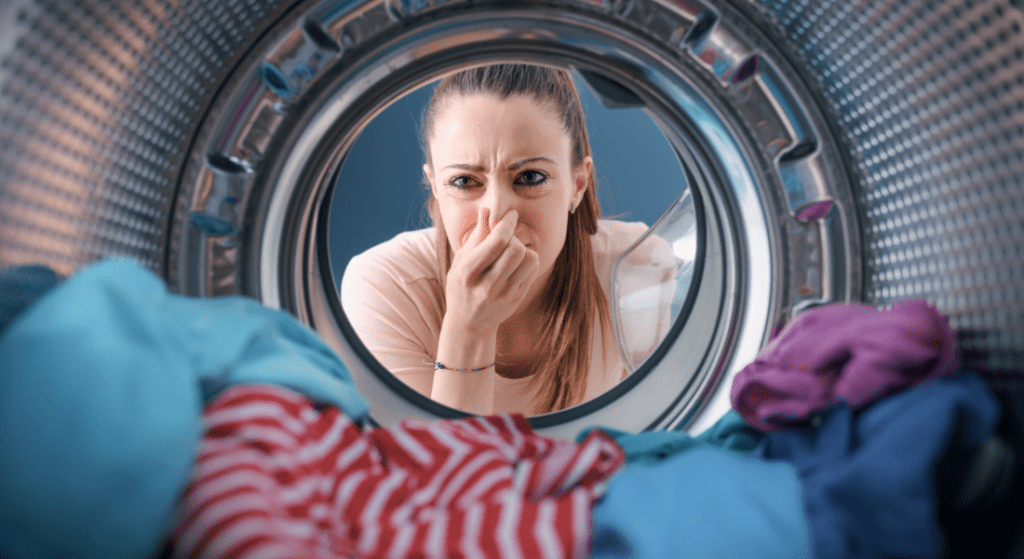
8 Reasons Clothes Still Smell After Washing
1. Too much detergent was used
Adding more detergent does not automatically make laundry cleaner. An excessive dose can create more suds than the washer can rinse away. The remaining residue may hold body oils, dirt and odor-producing material against the fabric.
Concentrated detergent requires particularly careful measuring. Follow the detergent label and washer manual rather than filling the cap automatically.
2. The washer was overloaded
Clothes need room to move through the wash water. A tightly packed washer limits mechanical action and prevents detergent and rinse water from reaching every surface.
Large loads are especially problematic for towels, jeans, uniforms, bedding and family laundry. Divide an overloaded batch into smaller loads or use an appropriately sized commercial washer.
3. The washing machine needs cleaning
Detergent, fabric softener, lint, soil and moisture can collect inside the drum, dispensers, door gasket and pump filter. If the empty washer smells musty, it can transfer that odor to clean laundry.
Front-load washers often retain moisture around the rubber door gasket. Top-load machines can also develop odors when the lid stays closed and the interior cannot dry.
4. Wet clothes remained in the washer
Leaving clean laundry in a closed washer creates a warm, damp environment where odor can develop. The longer the load sits, the more likely it is to smell musty or sour.
Move clothes to the dryer or drying rack promptly. If they already smell, run another complete wash cycle instead of drying them and hoping the smell disappears.
5. The clothes did not dry completely
Thick waistbands, pockets, towels, hoodies, blankets and tightly packed dryer loads may remain damp after the rest of the load feels dry. Folding or storing damp items can create a musty odor.
Separate heavy items from lightweight clothing when necessary and confirm that seams, cuffs and thick sections are fully dry before storage.
6. Sweat and body oils remain in the fibers
Sweat itself is not the only source of body odor. Skin oils, deodorant, dead skin and product residue can collect around shirt collars, underarms, waistbands, socks and activewear.
A normal wash may not fully remove heavy buildup. Pretreat odor-prone areas with a detergent suitable for the fabric and allow the recommended contact time before washing.
7. The wash temperature or cycle was unsuitable
A short or delicate cycle may not provide enough cleaning action for heavily soiled laundry. However, simply using very hot water is not always safe or effective.
Check the garment care label and select the warmest safe temperature and an appropriate cycle. Dark clothing, stretch fabric and performance wear may require cooler water, so compensate with the correct detergent, adequate movement and sufficient cycle time.
8. The detergent does not match the washer, load or water
High-efficiency washers generally require HE detergent. Using the wrong detergent may create excess suds and residue.
Too little detergent can also leave soil behind, particularly in heavily soiled loads or hard water. Follow the detergent and washer instructions while considering load size, soil level and water hardness.
How to Get Bad Smells Out of Clothes After Washing
Step 1: Smell the empty washing machine
Remove the laundry and check the drum, dispenser, gasket and surrounding area. If the empty washer smells similar to the clothes, clean the machine before rewashing anything.
Step 2: Check the garment care labels
Separate items that need cold water, gentle cycles, hand washing or professional cleaning. Do not use a stronger chemical or hotter temperature than the fabric allows.
Step 3: Divide an oversized load
Rewash the laundry in a smaller batch. Clothes should be able to move freely rather than being tightly compressed.
Step 4: Use the correct detergent and dose
Use HE detergent when the washer requires it. Measure according to the detergent label, washer instructions, load size, soil level and water hardness.
Avoid adding extra detergent to compensate for the odor. If residue is part of the problem, additional detergent can make it worse.
Step 5: Pretreat odor-heavy areas
Apply a suitable liquid detergent or laundry pretreatment to underarms, collars, socks and other odor-prone areas. Follow the product’s contact-time directions and do not allow it to dry unless instructed.
Step 6: Select the appropriate cycle
Use the warmest temperature and longest suitable cycle permitted by the care label. A normal or heavy-duty cycle may be more appropriate than a quick wash for odor-heavy laundry.
Step 7: Add an extra rinse if residue is suspected
An extra rinse can help when clothes feel coated, stiff or heavily fragranced. It is also useful after an accidental detergent overdose.
Step 8: Dry immediately and completely
Transfer the load as soon as the wash cycle finishes. Use the drying method and temperature stated on the care label.
Check the clothing before folding. If the odor remains, identify the unresolved cause instead of adding fragrance or storing the item.
How to Remove a Musty or Mildew Smell from Clothes
A musty smell commonly develops when laundry remains damp in a closed washer, hamper, gym bag or storage container. It can also transfer from a washer containing residue or visible mold.
- Remove the clothing from the damp environment.
- Check the fabric for visible spotting or damage.
- Clean the washer first if its empty drum smells musty.
- Rewash the clothing in a smaller load with the proper detergent dose.
- Use the warmest temperature allowed by the care label.
- Select an extra rinse when detergent residue may be present.
- Dry the clothing immediately and completely.
If visible mold remains after washing, the fabric is damaged, or the odor repeatedly returns, professional cleaning or replacement may be necessary.
Why Do Dark Clothes Smell After Washing?
Dark clothes often receive cold-water cycles to protect their color. Cold water can clean effectively when paired with the right detergent and cycle, but odor may remain when the load is oversized, heavily soiled or coated in product residue.
Dark denim and synthetic clothing can also hold body oils. Fabric softener may leave a coating that traps odor, especially on moisture-wicking materials.
- Turn dark clothing inside out to expose odor-prone areas.
- Do not pack the washer tightly.
- Use a detergent that dissolves effectively at the selected temperature.
- Measure detergent carefully.
- Skip fabric softener on performance fabrics when the care label recommends avoiding it.
- Use an extra rinse if clothes feel coated.
- Dry immediately after washing.
For color-protection guidance, read our guide on washing dark and black clothes without unnecessary fading.
Why Do Clothes Smell Sour After Washing or Drying?
A sour smell often points to damp laundry, incomplete rinsing, body-oil buildup or a washer that needs cleaning.
If the odor appears only after drying, warmth may be making a remaining odor easier to notice. The dryer may also have restricted airflow, a dirty lint screen or a maintenance problem.
- Rewash the clothing instead of adding more dryer time.
- Clean the lint screen.
- Confirm that the dryer vent and airflow are functioning properly.
- Do not overload the washer or dryer.
- Dry thick and lightweight items separately when needed.
Stop using an appliance and arrange service if you notice a burning, electrical, gas or overheating smell. Those are equipment-safety issues rather than normal laundry odors.
Why Do Gym Clothes and Polyester Still Smell?
Synthetic fabrics such as polyester, nylon and spandex can retain body oils and odor more stubbornly than many natural fibers. Tight weaves and moisture-wicking finishes can make residue difficult to rinse away.
- Air out damp workout clothing instead of leaving it in a closed bag.
- Turn garments inside out before washing.
- Pretreat underarms and other odor-heavy areas.
- Use the detergent and cycle recommended for activewear.
- Avoid excessive detergent.
- Avoid fabric softener when the garment label advises against it.
- Do not overcrowd the washer.
- Dry according to the care label.
Do not use chlorine bleach on stretch activewear unless the label specifically permits it. Bleach and high heat may damage elastic fibers.
What If Clothes Smell Like Detergent or Perfume?
A strong detergent smell is different from a musty or sour odor. It usually means fragrance or product residue remains in the fabric.
- Run an additional rinse without adding more detergent.
- Rewash heavily coated items using a carefully measured fragrance-free detergent.
- Avoid fabric softener, scent beads and dryer sheets until the fragrance is reduced.
- Do not use heat to cover the smell.
- Air-dry the item first and reassess it after it is completely dry.
For fragrance-specific treatment, use our separate guide on how to get perfume and strong fragrance smells out of clothes.
Is Laundry Detergent Causing the Odor?
Detergent may contribute to odor when:
- Too much is used.
- A concentrated formula is not measured correctly.
- Non-HE detergent is used in an HE washer.
- The cycle does not provide enough rinsing.
- The washer is overloaded.
- Pods or powder do not dissolve completely.
- Fragrance is masking rather than removing the original odor.
If you are uncertain which product suits your machine and laundry, see our guide to choosing an appropriate laundry detergent.
How to Clean a Smelly Washing Machine
Always follow the cleaning instructions for your exact washer model. Do not assume that a vinegar, baking-soda or bleach method is compatible with every machine.
- Empty the washing machine completely.
- Read the owner’s manual and locate the recommended cleaning cycle.
- Remove and clean detergent and fabric-softener dispensers when the manual permits it.
- Wipe the door, glass and rubber gasket of a front-load washer.
- Check and clean the pump filter according to the manufacturer’s directions.
- Run the self-clean or clean-washer cycle with the approved product.
- Dry the gasket and drum after the cycle.
- Leave the door or lid open between uses when the manufacturer recommends it and it can be done safely around children and pets.
If water remains in the machine, it drains slowly, or sewage-like odor comes from the drain, the problem may require appliance or plumbing service.
Can You Use Vinegar or Baking Soda for Smelly Laundry?
Vinegar or baking soda may help with some washable fabrics, but neither should be treated as a universal solution.
- Check the garment care label first.
- Check the washer manual before placing either product in the machine.
- Use only one treatment at a time.
- Rinse the fabric before trying another cleaner.
- Never mix vinegar with chlorine bleach.
- Do not combine household cleaners unless their labels explicitly permit it.
Some washer manufacturers discourage repeated vinegar use because acid may affect certain rubber components. A washer-cleaning product approved for the machine is the safer default.
How to Prevent Clothes from Smelling After Washing
- Do not leave sweaty or wet clothing in a closed hamper or gym bag.
- Remove laundry promptly when the wash cycle finishes.
- Measure detergent instead of guessing.
- Use HE detergent when required.
- Avoid overloading the washer.
- Choose a cycle that matches the soil level and fabric.
- Use fabric softener only when appropriate.
- Clean the washer according to its manual.
- Let the washer interior dry between loads when recommended.
- Clean the dryer lint screen after every load.
- Dry clothes completely before folding or storing them.
When Should You Replace or Professionally Clean an Item?
Consider professional cleaning or replacement when:
- The garment is marked dry-clean-only.
- Visible mold remains after appropriate washing.
- The odor returns immediately after every wash.
- Contamination has damaged the fabric.
- The odor comes from fuel, chemicals or an unknown hazardous substance.
- The garment causes coughing, irritation or another physical reaction.
Do not place clothing contaminated with gasoline, solvents or other flammable substances in a washer or dryer until you have followed the product’s safety instructions.
Help for Odor-Heavy Laundry in Clarksville
Sometimes the problem is not the garment—it is a washer that is too small for the load. Comforters, towels, uniforms and family-size laundry need enough space for water, detergent and rinse water to move through the fabric.
The Dutchman’s Laundry provides large-capacity self-service laundry in Clarksville and a drop-off wash, dry and fold service. Tell an attendant about persistent odor or product sensitivity before dropping off the items so the team can assess the appropriate laundry options.
Frequently Asked Questions
Why do my clothes still smell after washing?
The most common causes are detergent residue, an overloaded washer, body oils left in the fabric, laundry sitting wet, incomplete drying or buildup inside the washing machine.
Why do my clothes smell musty after washing?
A musty smell usually indicates that the clothes remained damp too long, did not dry completely or were washed in a machine containing moisture and residue. Clean the washer, rewash the clothes and dry them immediately.
How do I get a mildew smell out of clothes?
Check the care label, clean the washer if necessary, and rewash the clothes in a smaller load with the correct detergent dose. Use the warmest permitted water, rinse thoroughly and dry completely. Persistent visible mold may require professional care or replacement.
Why do dark clothes smell after washing?
Dark clothes are often washed in large cold-water loads. Odor may remain when there is insufficient movement, excessive detergent, fabric-softener buildup or body oil trapped in denim and synthetic fibers.
Why does laundry smell sour after drying?
The original odor may not have been fully removed, the load may have dried too slowly, or thick sections may still be damp. Rewash the clothes and check the dryer’s lint screen, airflow and vent.
How do I remove detergent smell from clothes?
Run an extra rinse without adding more product. If necessary, rewash using a small amount of fragrance-free detergent and avoid fabric softener, scent beads and dryer sheets.
Will an extra rinse remove laundry odors?
An extra rinse can help when detergent, fragrance or fabric-softener residue is contributing to the smell. It will not fix odor caused by a dirty washer, remaining body oils or laundry that was stored damp.
Should I wash smelly clothes in hot water?
Use only the warmest water permitted by the garment’s care label. Hot water may damage dark clothing, elastic, wool, delicate fabrics and some finishes. Proper detergent, load size and cycle selection are equally important.
Why does only one item still smell after washing?
The item may contain a synthetic fabric, heavy body-oil buildup, a thick section that did not dry, or residue from deodorant, fabric softener or fragrance. Pretreat it separately and follow its care label.
Final Laundry-Odor Checklist
- Smell the empty washer.
- Clean the machine according to its manual.
- Check every garment’s care label.
- Reduce an overloaded batch.
- Measure the correct detergent dose.
- Pretreat odor-heavy areas.
- Select the appropriate temperature and cycle.
- Add an extra rinse when residue is suspected.
- Remove laundry immediately after washing.
- Dry every item completely before storage.
Persistent laundry odor is usually a sign that soil, residue or moisture remains somewhere in the process. Correcting the cause produces better results than covering the smell with additional fragrance.
About The Dutchman’s Laundry Team
The laundry professionals behind The Dutchman’s Laundry in Clarksville, Tennessee share practical guidance based on the laundry questions and odor-heavy loads customers bring to our laundromat. Our recommendations prioritize care labels, proper washer loading, accurate detergent use and complete rinsing and drying.